Designer
Draw a mechanism on the canvas: pins, links, sliders, gears, belts, cams, springs and motors. Drag it, run it, save and share it. New sketch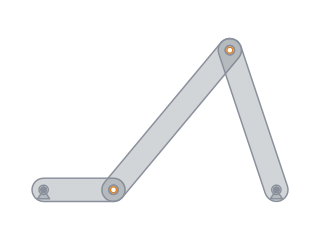
Crank, coupler and rocker on two ground pivots: the crank turns fully while the rocker swings. Drag any pin.
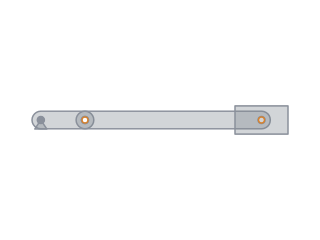
A crank and connecting rod drive a piston along a ground axis; the stroke is twice the crank radius.
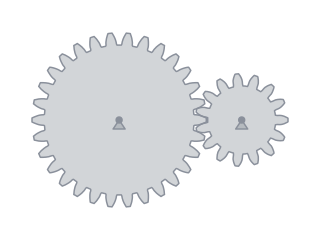
Two spur gears meshed by their centre distance m(z1+z2)/2: the small gear turns twice as fast the other way.
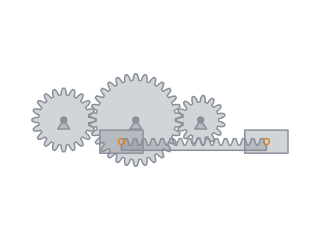
Three meshed spur gears pass the drive along and the last one drives a rack that slides on two guides.

An open belt wraps a 40-tooth driver and a 20-tooth driven pulley: the driven pulley turns twice as fast (a 2:1 speed-up) the same way; crossing the belt reverses it.
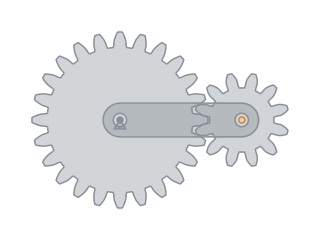
A sun gear held still, a planet riding on an arm: the mesh is measured against the arm (the carrier), so the planet turns (1 + zs/zp) times per arm turn.
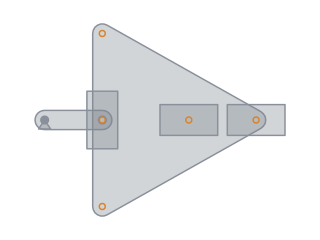
The crank pin slides in the slot of a yoke that runs on guides, so the yoke moves in pure simple harmonic motion x = r cos θ.
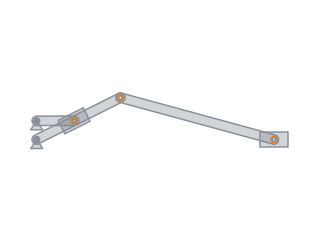
A crank pin slides in a lever pivoted below the crank; the lever works a ram whose forward stroke takes longer than its return.
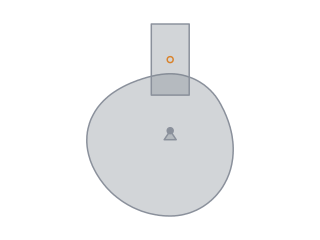
A disk cam lifts a roller follower on a guide: cycloidal rise, dwell, harmonic return, dwell.
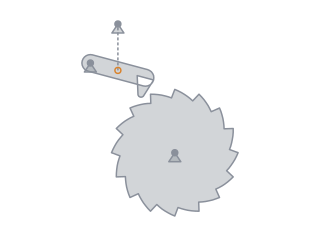
A spring-loaded pawl rides over the teeth one way and catches them the other. Dynamic: set the wheel drive positive and the pawl locks it.
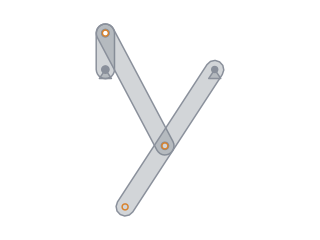
A handle crank drives a clamp arm through a short link; where handle and link line up the arm locks with a huge mechanical advantage.
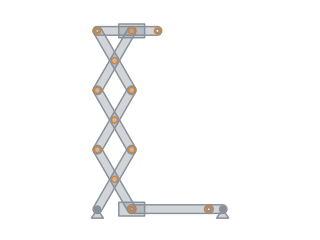
Three X stages of crossed bars: a crank pushes the sliding foot and the platform rises and falls several times as far.
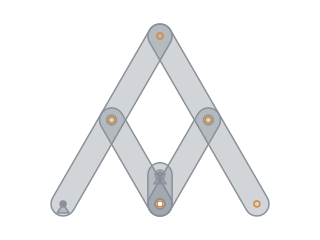
A parallelogram of bars copies the tracer's path at twice the size: the pen always sits on the line from the pivot through the tracer.
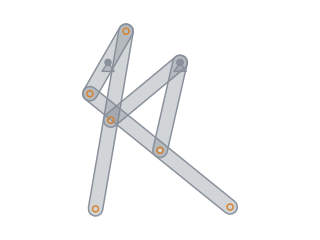
Two Chebyshev lambda legs (ground 2, crank 1, coupler and rocker 2.5, foot at twice the coupler) on one crank, half a turn apart: each foot runs flat along the ground.
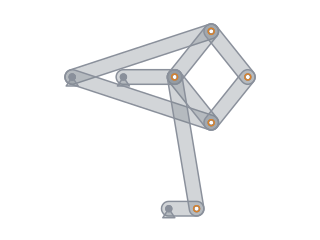
The Peaucellier–Lipkin inversor turns the arc of the input arm into an exact straight line; a small crank rocks the arm.
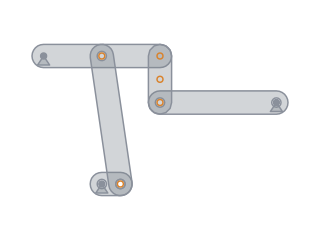
Two equal rockers pivoted on opposite sides and a short coupler: the coupler midpoint moves on a nearly straight line. A small crank rocks the left rocker.
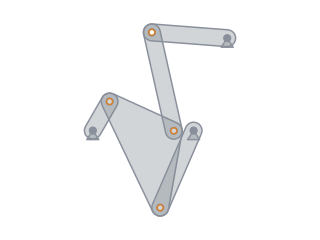
A crank-rocker four-bar whose ternary coupler drives a second rocker through a dyad: two ternary links that never touch (Stephenson type).
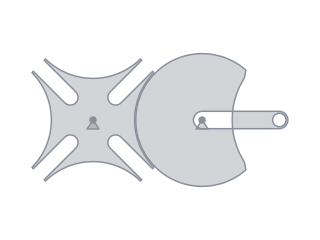
A pin on the turning driver indexes a four-slot wheel a quarter turn per revolution; the locking disc holds it still in between. Dynamic.
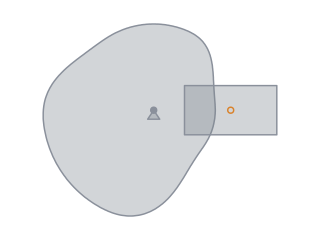
A stepped cam program pushes a slide forward in two equal steps with dwells between them, then returns it: indexing from a steadily turning shaft.
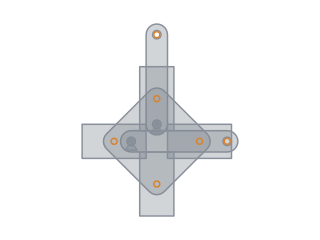
Two parallel but offset shafts turn together: the centre disc slides in a slot of each hub, the two slots at right angles.
MDL designer (JSON model, 3D viewport, every part type)
Write the model directly: out-of-plane axes, custom parts, scripts. A sketch can be handed over here with its 3D button.